Can I tell you something that took me way too long to figure out? Jam doesn’t need pectin. It doesn’t need a candy thermometer, a canning kit, a water bath, or any of that equipment that makes jam-making sound like a chemistry lab project. Blackberries — real, gorgeous, tart blackberries — have all the natural pectin they need right there in their seeds. All you have to do is give them a little heat and some time, and they’ll do the rest themselves.
I know jam can feel intimidating. The recipes that float around online are full of caveats and steps and “make sure you sterilize your jars properly or you’ll give someone botulism” warnings, and honestly, no wonder people just buy Smuckers. But here’s the truth: jam is one of the oldest, simplest things humans have ever made. People were putting fruit and sugar in a pot over a fire centuries before pectin packets existed. We just forgot that somewhere along the way.
This recipe is what I make every single summer when blackberries come into season, and I’ve made it so many times I could do it with my eyes closed. You need one pot, three ingredients, and about 45 minutes, and you will end up with two jars of the most deeply flavored, jewel-colored blackberry jam you’ve ever tasted. Let’s do this.
What You’ll Need
For 2 jars:
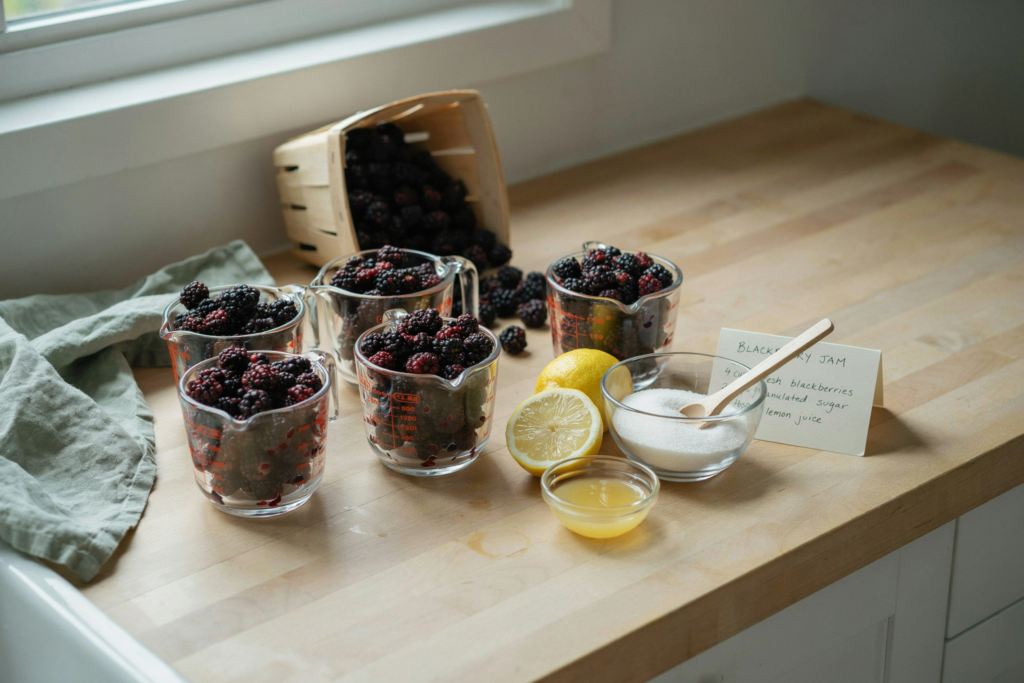
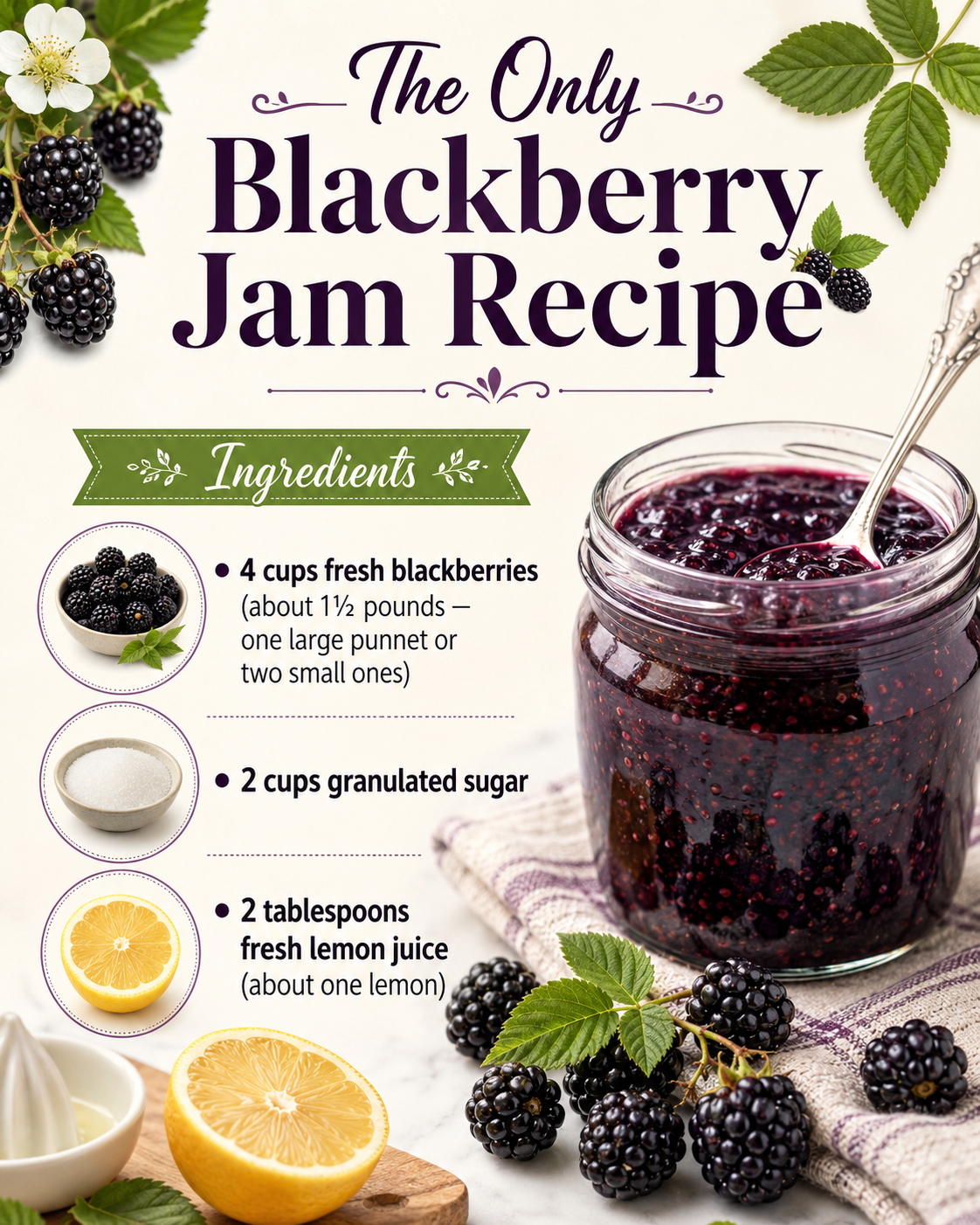
- 4 cups fresh blackberries (about 1½ pounds — one large punnet or two small ones)
- 2 cups granulated sugar
- 2 tablespoons fresh lemon juice (about one lemon)
That’s it. Three things. The lemon juice isn’t just for flavor — the acidity helps activate the natural pectin in the blackberries and keeps the color bright and gorgeous. Don’t skip it.
Equipment you’ll actually need:
- One wide, heavy-bottomed saucepan (the wider the better — more surface area means faster evaporation means faster jam)
- A wooden spoon or silicone spatula
- A potato masher or fork
- Two clean jars with lids (any size works — two half-pint / 8 oz jars is the sweet spot)
- One small plate in the freezer (more on this in a minute)
Step-by-Step Instructions
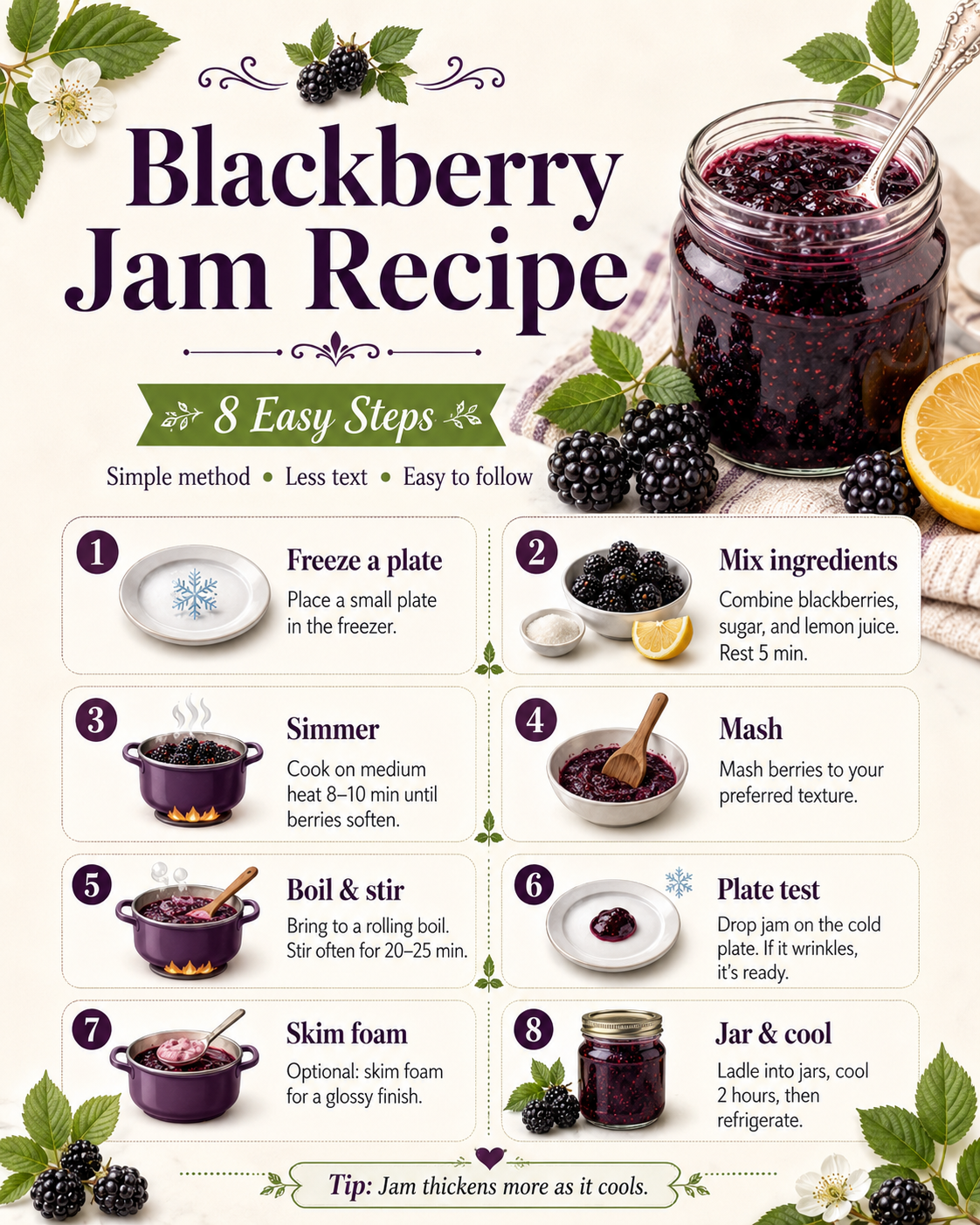
See the interactive recipe card above to follow along with built-in timers for each step!
Step 1: Put a small plate in the freezer. Do this before you do anything else. A small ceramic plate works best. You’ll use it to test whether your jam has set, and it needs to be genuinely cold when you need it — not just cool. This is your secret weapon, and it costs exactly zero dollars.
Step 2: Combine your three ingredients in the pot. Add the blackberries, sugar, and lemon juice to your saucepan and give everything a stir. The sugar will start coating the berries immediately. Let it sit for about 5 minutes — you’ll see the berries start to weep their gorgeous dark juice and the sugar will begin to dissolve. It’ll look a little messy and very beautiful.
Step 3: Bring to a simmer over medium heat. Turn on your burner to medium — not medium-high, not high, medium — and stir gently as everything heats up. The sugar will fully dissolve, the berries will start to soften and slump, and the whole thing will become this incredible deep purple liquid with softening fruit suspended in it. This takes about 8–10 minutes. Don’t rush it by cranking the heat. Good jam is patient jam.
Step 4: Mash to your preferred texture. Once things are bubbling gently, grab your potato masher or the back of a wooden spoon and go to town on those berries. Do you like chunky jam with whole berry pieces? Leave some intact. Do you prefer something smoother and more spreadable? Mash thoroughly. Personally, I like it somewhere in the middle — mostly smooth with the occasional soft berry chunk. There is no wrong answer here. It’s your jam.
Step 5: Boil hard, and stir often. Now increase the heat slightly to bring the jam up to a rolling boil — the kind that doesn’t stop bubbling even when you stir. This is where the actual jam-making happens. Keep stirring every minute or two, scraping the bottom of the pot as you go, because this is when scorching can happen if you walk away. The jam will bubble vigorously, darken in color, and slowly thicken over about 20–25 minutes. You’ll be able to see it getting jammier. It’s very satisfying.
Step 6: Do the plate test. At the 20-minute mark, grab your frozen plate. Drop a small spoonful of jam onto it and let it sit for 30 seconds. Then push it gently with your fingertip. If the surface wrinkles and the jam holds its shape rather than flowing back together, your jam is set and you’re done. If it spreads out like syrup, give it another 5 minutes and test again. (More detail on this below — it’s the one thing worth understanding well.)
Step 7: Skim the foam (optional, but satisfying). There’s likely some pinkish-purple foam sitting on the surface of your jam. You can skim it off with a spoon and discard it. It’s completely harmless if you leave it — it’ll disappear as the jam cools — but skimming it off gives your finished jam that clear, glossy, jewel-like look that makes people say “did you actually make this yourself?!”
Step 8: Ladle into jars and let cool. Carefully pour or ladle the hot jam into your clean jars, leaving about half an inch of space at the top. The jam will be extremely hot, so use a ladle or pour carefully. Set the jars on the counter and let them cool completely — at least 2 hours — before putting the lids on and transferring to the fridge. This is crucial: the jam will thicken significantly as it cools. If it looks a little runny when it’s still hot, don’t panic. Give it time.
How to Know When Your Jam Is Ready: The Plate Test
This deserves its own section because it’s genuinely the only skill you need to make jam successfully, and once you understand it, you’ll feel totally confident.
Before you start cooking, put a small ceramic plate in the freezer.
When your jam has been at a rolling boil for about 20 minutes, remove the pot from the heat (so the jam stops cooking while you test), then drop a small spoonful onto the cold plate and wait 30 seconds.
Now gently push the jam with your fingertip. You’re looking for two things:
- The surface should wrinkle slightly as you push it, like a very thin skin has formed on top
- The jam should hold its shape and not immediately flow back to fill the space your finger made
If it does both of those things: you’re done. Pull it off the heat and get your jars ready.
If the jam flows back together like liquid: it needs more time. Return the pot to the heat, boil for another 5 minutes, and test again. Repeat until it passes.
Other signs your jam is ready: it will look noticeably darker and more translucent than when you started, it will have reduced in volume by roughly a third, and when you drag a spoon through it, it should leave a clear trail that fills in slowly rather than immediately. You’ll know.
Storage Guide
In the refrigerator: Once cooled and sealed with lids, your jam will keep in the fridge for up to 3 weeks. Use a clean spoon each time you scoop into it (no double dipping with a knife that’s been on your toast) and it’ll last the full stretch.
In the freezer: Jam freezes beautifully. Leave at least an inch of space at the top of the jar before freezing, since the jam will expand. Frozen jam keeps for up to a year. Thaw overnight in the fridge when you’re ready to use it.
For longer shelf-stable storage: You’ll want to look up proper water-bath canning, which extends shelf life to 12+ months and lets you store jars at room temperature. But honestly? With this batch size, you probably won’t need it. Two jars of this jam have a way of disappearing very quickly.
Troubleshooting
My jam didn’t set — it’s more like blackberry syrup.
First, don’t panic — you have delicious blackberry syrup, which is genuinely wonderful on ice cream, pancakes, and sparkling water. But if you want to rescue it as jam, you can! Pour it back into the pot, bring it back to a rolling boil, and cook for another 10–15 minutes, testing with your plate every 5 minutes. Sometimes jam just needs more time to reduce. It can also help to add an extra tablespoon of lemon juice, which boosts the acidity and helps the natural pectin do its job. One more thing: if your berries were very ripe and sweet, they may have had lower natural pectin — slightly underripe berries actually set better.
My jam is too sweet — it tastes like candy, not blackberries.
This usually means your berries needed a little more tartness to balance the sugar. The fix for next time is easy: use slightly less sugar (you can go as low as 1½ cups to 4 cups of berries) or add an extra half-tablespoon of lemon juice. For the batch you’ve already made, try serving it with something that adds contrast — sharp aged cheddar, plain Greek yogurt, or a slice of sourdough — and the balance will come back. The sweetness also mellows slightly after a day or two in the fridge as the flavors settle.
Can I use frozen blackberries?
Yes, absolutely, and they work almost perfectly. Frozen blackberries were picked at peak ripeness and frozen quickly, which often makes them more flavorful than out-of-season fresh berries. No need to thaw them first — just add them to the pot from frozen and expect the initial cooking time to be a few minutes longer while they come up to temperature. You may also get slightly more liquid in the pot from the thawing process, so the boiling-down stage might take a bit longer. Just keep going and trust the plate test. The finished jam will be just as good.
Three Ways to Use This Jam (Beyond Toast)
Blackberry jam on toast is a complete joy and I will defend it forever. But this jam is too good to stay in one lane. Here’s where else it belongs:
1. Spread on brie and serve with crackers. Put a wheel of brie on a small board, spoon a generous amount of blackberry jam on top, and scatter some walnuts or pecans around it. The creamy, buttery richness of the brie and the sweet-tart intensity of the jam are one of those combinations that makes guests think you spent a lot of effort on something that took you three minutes.
2. Use as the filling in thumbprint cookies. Blackberry jam is the perfect thumbprint cookie filling — it’s tart enough to cut through the buttery sweetness of the cookie, and it turns that jewel-dark purple against golden dough into something almost too pretty to eat. Just fill the indentations before baking and let the jam bubble gently in the oven. Your kitchen will smell extraordinary.
3. Swirl into yogurt or overnight oats. Spoon a tablespoon of blackberry jam into plain Greek yogurt and swirl it through — you’ll end up with something that looks like it came from a fancy brunch spot and tastes even better. The same works for overnight oats: add a spoonful on top before you put it in the fridge, and by morning it’s swirled in beautifully. It adds sweetness, flavor, and that gorgeous purple color that makes breakfast feel like a treat.
The most important thing I want you to take away from this recipe isn’t the ratios or the technique or even the plate test — it’s the confidence that you can do this. Jam is forgiving. Blackberries want to become jam. And the version you make in your own kitchen, with your own hands, will taste better than anything you can buy in a store. I promise.
Happy jamming.