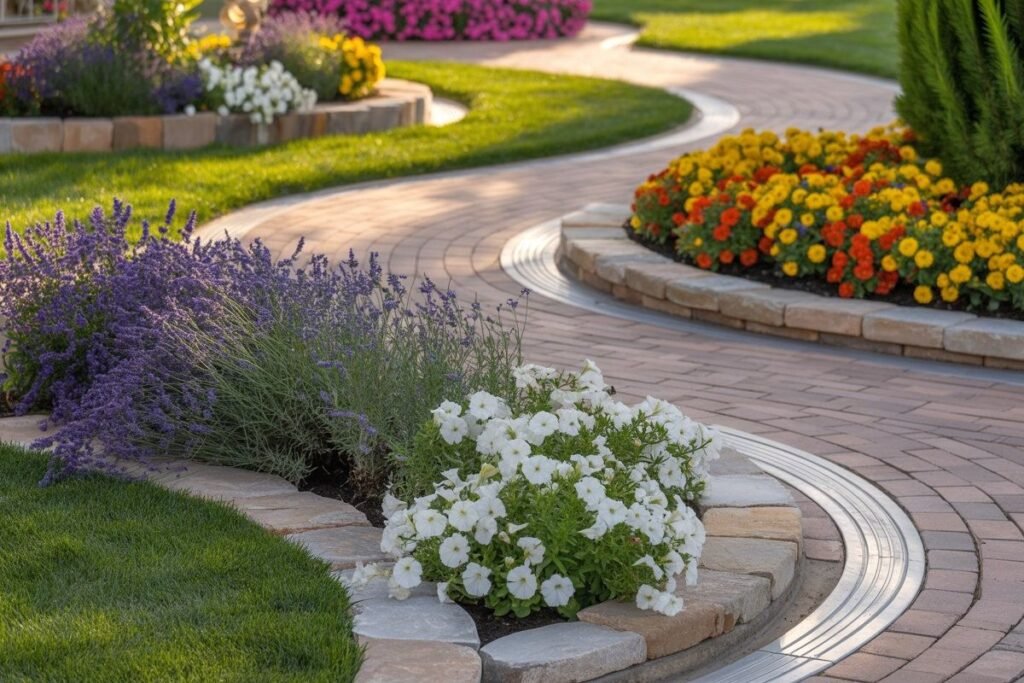
There is a rumor about roses, and it has been discouraging gardeners for decades.
The rumor goes like this: roses are fussy, demanding, disease-prone prima donnas that require a dedicated weekly spray schedule, a degree in horticulture, and a willingness to bleed. That roses are for serious gardeners with serious time on their hands. That if you’re a beginner — or you have a small yard, or you’ve killed plants before — roses simply aren’t for you.
This rumor is outdated. And this article is going to retire it for good.
Here’s what the rumor doesn’t account for: the last thirty years of rose breeding have been extraordinary. Modern rose varieties — especially the shrub, groundcover, and disease-resistant lines developed since the 1990s — are genuinely different from the hybrid teas your grandmother wrestled with every June. They bloom prolifically, shrug off disease, survive cold winters without being swaddled in burlap, and require nothing more dramatic than a little sunshine, decent soil, and occasional pruning.
A rose garden is not a burden in disguise. It’s one of the most rewarding things you can grow — and you can start one this season, even in four square feet of space.
Let’s begin.
Planning Your Space
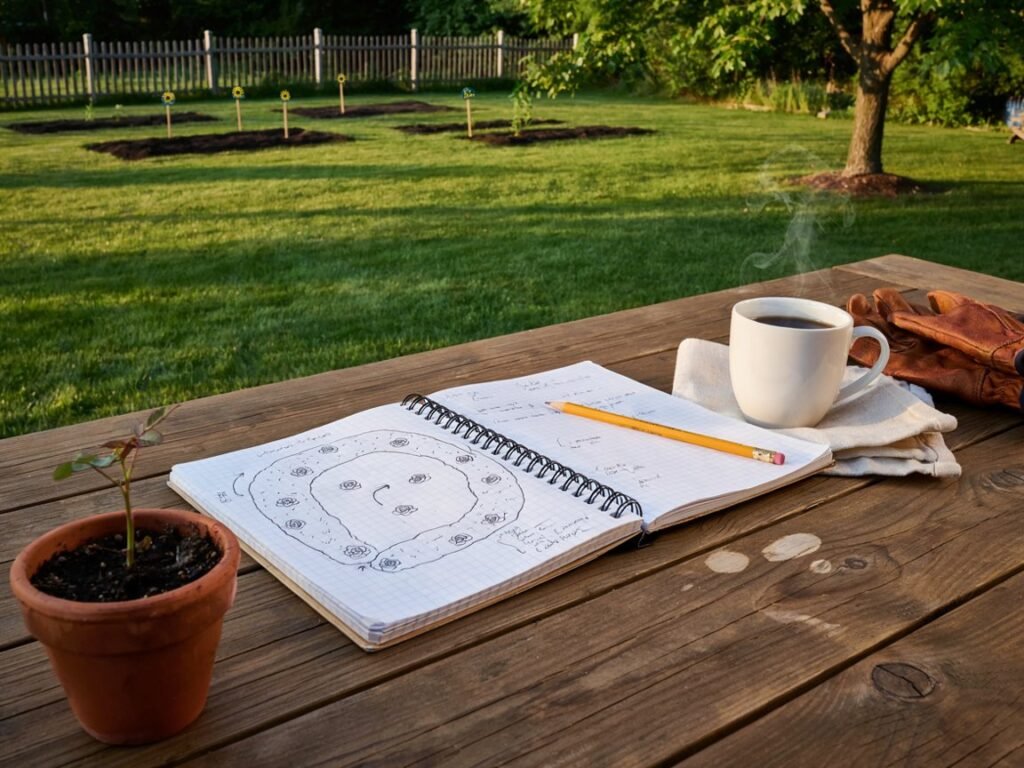
The single most important thing you can do for your rose garden happens before you buy a single plant. It happens with a notebook, a cup of coffee, and an honest look at the space you actually have.
Start With Sunlight
Roses need at least six hours of direct sunlight per day. This is the one requirement that cannot be negotiated — not with fertilizer, not with good intentions, not with especially encouraging words. Fewer than six hours and your roses will produce fewer flowers, become more susceptible to disease, and slowly decline no matter how well you care for them.
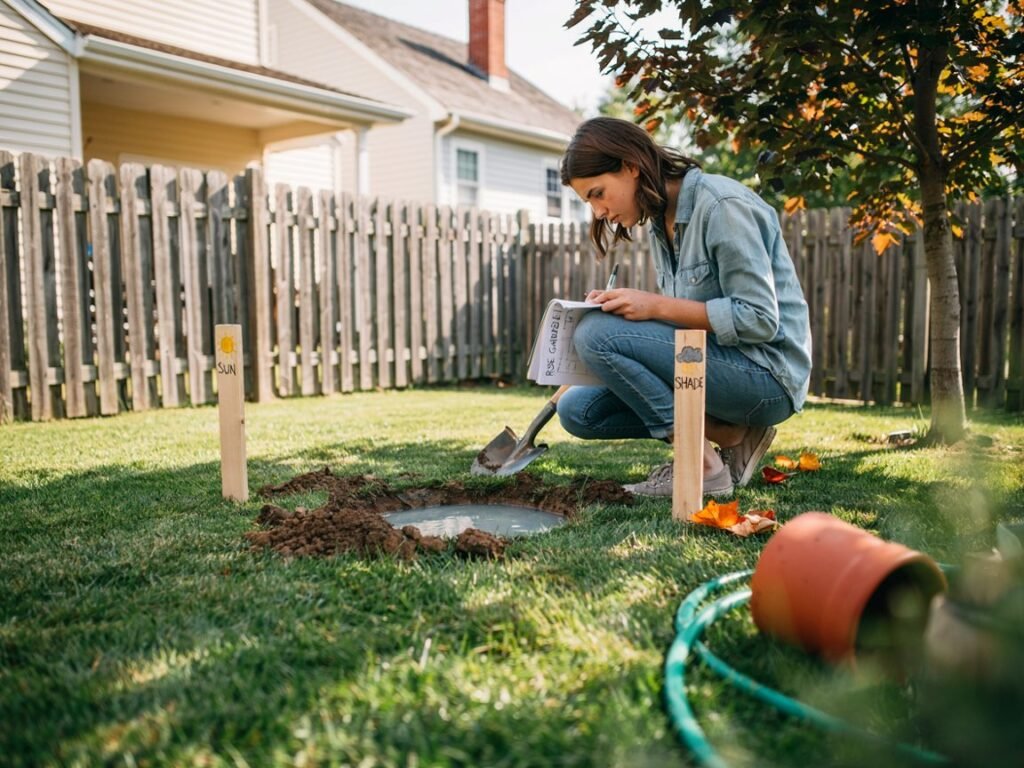
Spend a day or two actually tracking the sun in your garden before you commit to a location.
- Mark where the sun hits at 9am, 12pm, and 3pm
- Note which areas are shaded by fences, trees, or the house
- Look for spots that get morning sun especially — morning light dries the dew off leaves quickly, which dramatically reduces the chance of fungal disease
South-facing and west-facing spots are typically your best options. East-facing spots can work if the afternoon shade isn’t too heavy.
Assess Your Drainage
Roses are not water-lovers in the way that some plants are. They want consistent moisture at the root zone, but they absolutely cannot sit in waterlogged soil — their roots will rot.
To test your drainage:
- Dig a hole about 12 inches deep and 12 inches wide in your proposed spot
- Fill it with water and watch
- If the water drains away within an hour, your drainage is excellent
- If it’s still sitting there several hours later, you have drainage issues to address (more on how to fix this in Section 3)
If your soil drains poorly, raised beds are not a compromise — they’re often a superior choice. A raised bed gives you complete control over your soil quality, warms up faster in spring, and drains beautifully.
What a Rose Garden Can Look Like
This is where people get surprised — and relieved.
In 4×4 feet of space, you can plant one large shrub rose as a centerpiece with a low groundcover rose around its base, or two to three miniature roses in a cluster. This is enough for real, cutting-garden blooms. Enough for a corner of a patio, a front stoop, or a raised planter box. A 4×4 rose garden is not a consolation prize. It is a garden.
In a 4×10 foot border, you can plant a full mixed rose border — a climbing rose trained against a fence or wall at the back, two or three mid-size shrub roses in the middle ground, and groundcover or miniature roses at the front edge. This is the classic English cottage garden look, and it’s entirely achievable in a narrow strip along a fence or house wall.
In a larger space, a traditional rose garden with a central focal point (an obelisk, an arch, a sundial) surrounded by beds feels formal and intentional without being difficult. But start small. A garden you fall in love with is better than a project that overwhelms you.
Choosing the Right Roses for Beginners
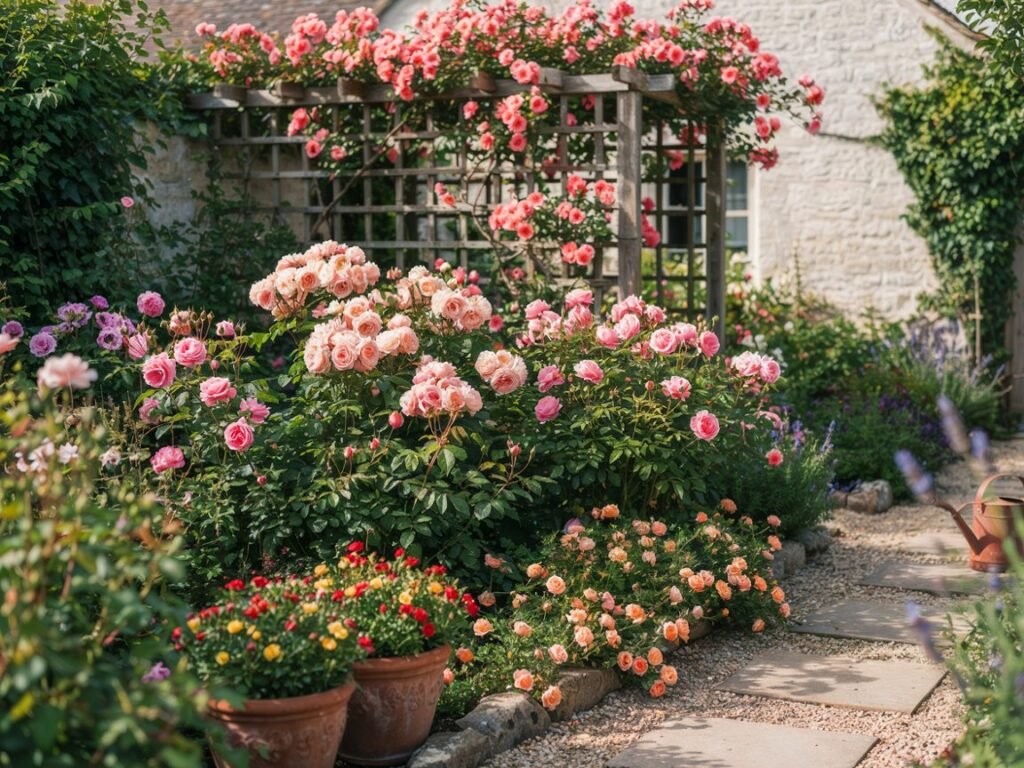
The world of roses is enormous — there are thousands of named varieties. But for a first rose garden, you only need to know about four categories, and within those categories, a handful of varieties that have proven themselves reliably beautiful and genuinely easy.
Shrub Roses — The Workhorse of the Modern Garden
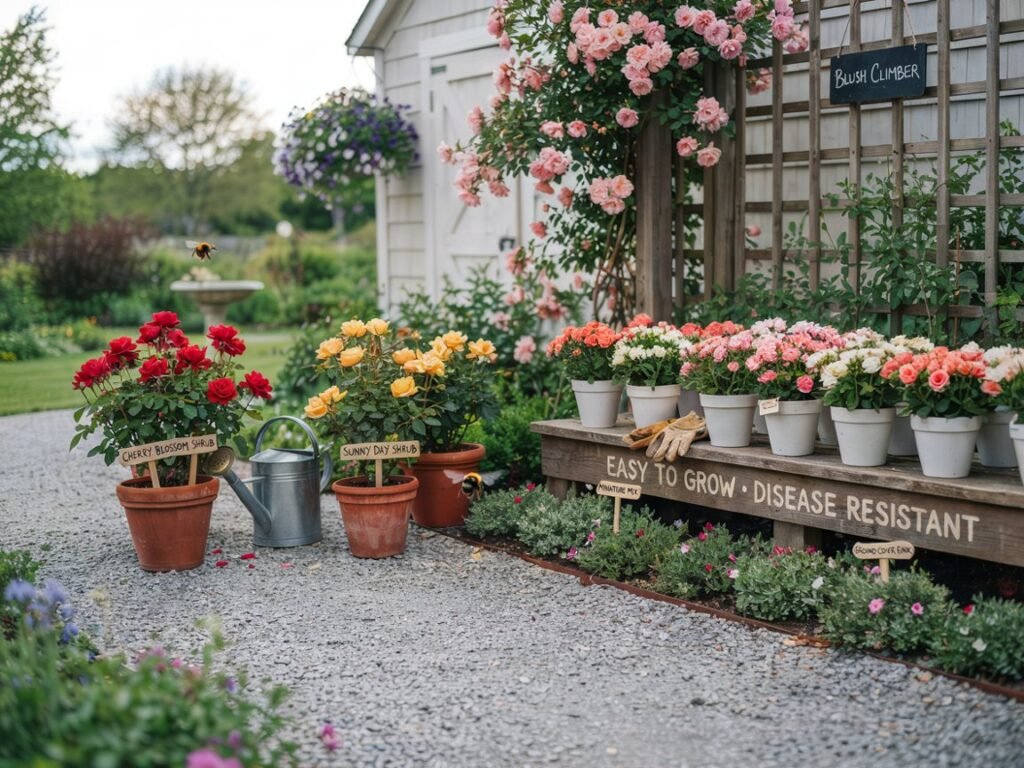
Shrub roses are the category that changed everything. These are the roses that laughed in the face of the old reputation — they bloom continuously from late spring through frost, resist disease without spraying, tolerate cold, and look abundant and lush with minimal effort. The Knock Out series (developed in 2000 and now one of the best-selling roses in North America) deserves its reputation entirely. ‘Double Knock Out’ produces rich cherry-red blooms in waves all season long and is virtually immune to black spot, the fungal disease that plagued older varieties. ‘Sunny Knock Out’ offers soft yellow blooms with a light citrus fragrance. For something a little more romantic, ‘Carefree Wonder’ produces large, semi-double pink blooms with a white reverse — it looks old-fashioned and elegant but behaves like a modern rose. Shrub roses typically grow 3–5 feet tall and wide, making them ideal for borders, mass plantings, or as single specimens with presence.
Climbing Roses — Vertical Drama Without the Difficulty
Climbing roses don’t actually climb the way a vine does — they don’t grip or twine. What they do is produce long, arching canes that you tie to a support structure (a fence, a trellis, an arbor, a wall), and once established, they produce cascades of blooms that are genuinely breathtaking. ‘New Dawn’ is the climbing rose that belongs in every garden — it’s one of the most celebrated varieties in the world, producing clusters of soft blush-pink, lightly fragrant blooms on vigorous, disease-resistant canes. It will cover a fence in three to four years and bloom reliably every summer once established. For a smaller space, ‘Blaze’ is a manageable climber with brilliant scarlet blooms and excellent cold-hardiness. Give a climbing rose a sunny fence or wall and it will reward you for decades.
Miniature Roses — Big Beauty in Small Packages
Miniature roses are exactly what they sound like — fully formed roses in miniature, producing perfect little blooms on compact plants that typically top out at 12–18 inches. They are ideal for containers, window boxes, patio edges, and small garden plots where a full-size shrub rose would overwhelm the space. ‘The Cupcake’ produces soft pink blooms with a classic high-centered form and a light fragrance. ‘Cinderella’ is a creamy white miniature with a delicate blush center and a lovely spicy scent. The most important thing to know about miniature roses is that despite their small size, they need exactly the same care as their larger cousins — full sun, good drainage, appropriate watering. They’re not houseplants; they’re outdoor roses in small format.
Groundcover Roses — The Slope-Savers and Edge-Softeners
Groundcover roses are low-growing, spreading varieties that cover the soil densely, suppress weeds, and produce sheets of blooms that look effortless. They are extraordinary on slopes (where erosion can be a problem), along the front edges of borders, or cascading over a retaining wall. ‘The Fairy’ is one of the best-loved roses of the 20th century — a compact, spreading plant that produces enormous clusters of tiny, perfectly formed blush-pink blooms all season long. It’s practically unkillable and unbelievably pretty. ‘Flower Carpet Pink’ is a modern groundcover variety specifically bred for disease resistance and repeat flowering, and it delivers on both counts. Groundcover roses grow 2–3 feet tall and 4–6 feet wide, and they’re the variety you plant when you want something that looks intentional and lush without any fussing.
Soil Prep, Planting Steps, and First-Year Care
Preparing Your Soil
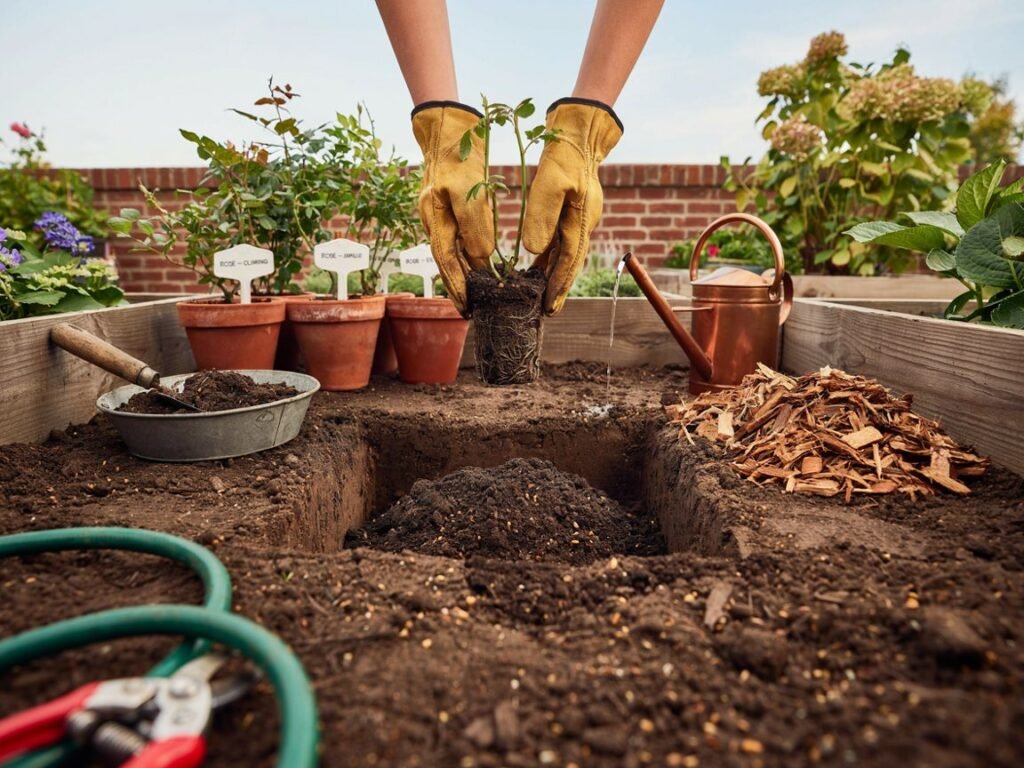
Good soil is not optional for roses — it is the foundation of everything. The good news is that improving your soil is straightforward once you know what you’re aiming for.
Roses want:
- Loamy, well-draining soil — not too sandy (drains too fast), not too clayey (holds too much water)
- A slightly acidic pH of 6.0–6.5 — if you’re unsure, a simple soil test kit from a garden center costs a few dollars and takes five minutes
- Plenty of organic matter — this is what gives soil its structure, its ability to hold moisture without waterlogging, and its biological life
To prepare your bed:
- Mark out your bed and remove any existing grass or weeds completely — don’t just dig them in or they’ll regrow
- Dig the bed to a depth of at least 18 inches (roses have deep roots)
- If your soil is heavy clay, add coarse sand and compost in roughly equal portions to improve drainage
- If your soil is sandy, add generous amounts of compost and aged manure to help it hold moisture and nutrients
- Mix in one or two inches of compost across the whole bed — this is the single best thing you can do for any garden soil
- If your soil test shows low pH, add garden lime according to the package directions; if it’s too acidic, add sulfur
- Let the bed settle for a few days before planting if you can
Planting Your Roses — Step by Step
- Dig a hole wide enough to accommodate the roots without crowding — roughly 18 inches wide and 18 inches deep
- Soak bare-root roses in a bucket of water for 12–24 hours before planting to rehydrate them; container roses can go straight in
- Make a small mound of soil in the center of the hole and drape bare roots over it naturally; for container roses, remove the pot gently and place the root ball in the hole
- Check the depth: the bud union (the swollen knob where the canes meet the roots) should sit just at or slightly below soil level in cold climates, and just above soil level in warm ones
- Backfill with your amended soil, firming gently around the roots as you go to eliminate air pockets
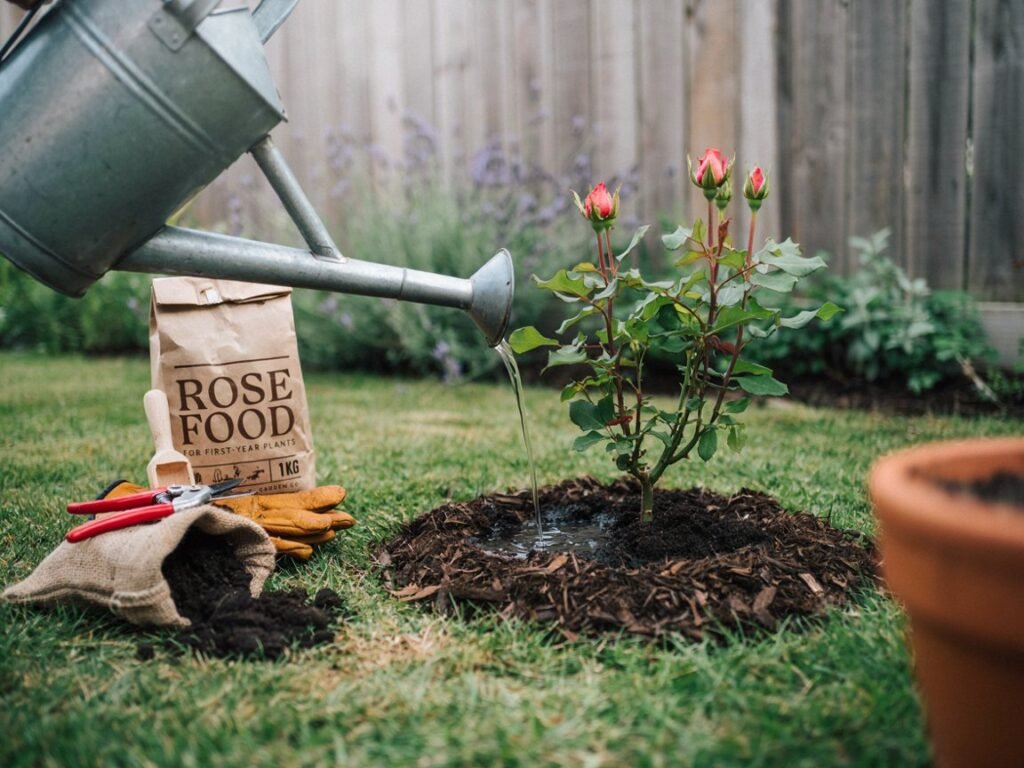
- Water deeply and slowly — let the water soak in, not run off
- Mound loose soil or mulch lightly around the base of the plant if you’re planting in fall or late in the season, to protect the bud union until established
- Apply 2–3 inches of mulch around (not touching) the base of the plant — this retains moisture, regulates soil temperature, and suppresses weeds
First-Year Care
The goal in the first year is simple: help your rose establish its root system. This is not the year you expect armloads of blooms. It’s the year you invest in the plant’s future.
- Water consistently — about one inch per week, delivered slowly and deeply rather than frequently and shallowly; deep watering encourages roots to grow downward rather than staying near the surface
- Water at the base, not overhead — wet foliage, especially in the evening, is an invitation to fungal disease
- Feed lightly — wait six weeks after planting before applying any fertilizer; when you do start, a balanced rose fertilizer applied according to package directions once a month through midsummer is plenty
- Resist the urge to prune heavily in the first year — let the plant grow and put its energy into roots
- Deadhead spent blooms on repeat-blooming varieties by snipping just above the first set of five-leaflet leaves — this signals the plant to produce the next flush of flowers rather than setting seed
What Nobody Tells You About the First Summer
Here is the honest conversation that gardening books sometimes skip over.
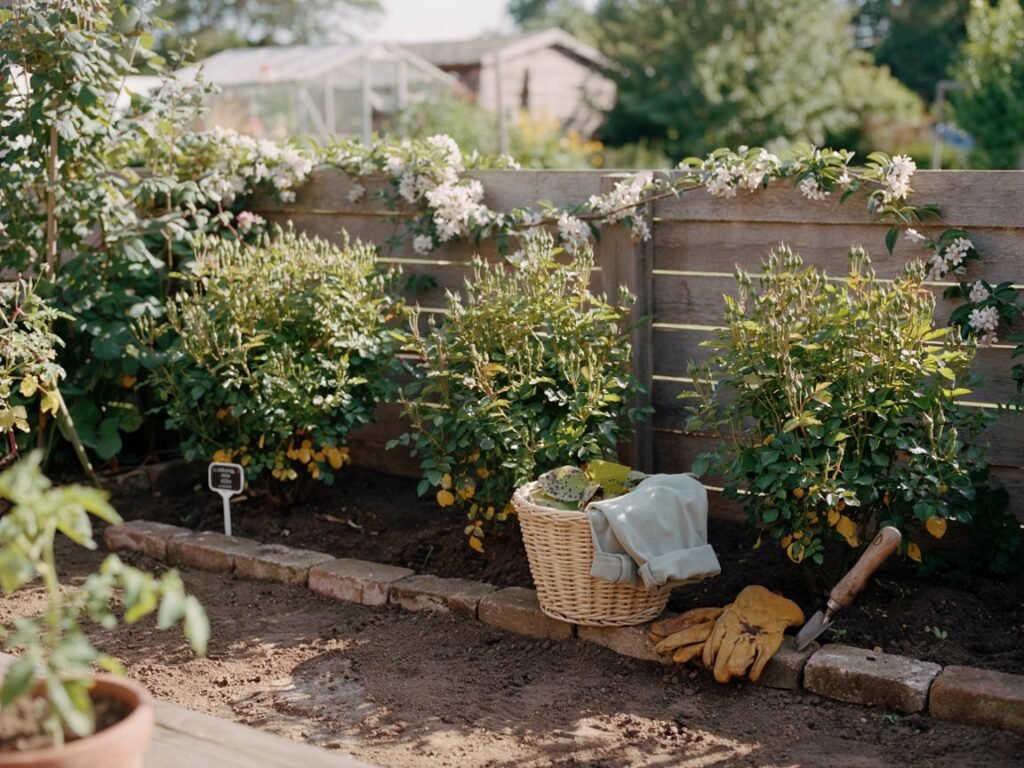
Your roses will look a little rough in early summer. Not all of them, and not every year, but especially with bare-root plants or small container plants, the first summer is more about settling in than showing off. You’ll see some yellowing leaves — this is normal transplant stress. You might see fewer blooms than the label promised — this is because the plant is spending its energy underground, building the root system that will fuel years of flowering. You may feel like you made a mistake. You probably didn’t.
Black spot may appear on the leaves. Black spot is a fungal disease that shows up as — you guessed it — black spots on the leaves, followed by yellowing and leaf drop. It is almost universal in first-year roses and nothing to panic about. Remove affected leaves promptly, don’t water overhead, and improve air circulation around the plant by thinning dense growth. If you planted disease-resistant varieties (the Knock Out series, The Fairy, New Dawn), you’ll see far less of this. If it persists, an organic fungicide spray applied preventatively in wet weather will help.
The second summer will be completely different. A rose that looked uncertain and sparse in its first year will often double in size, bloom prolifically, and look like a completely different plant in its second season. This is the reward for patience, and every experienced gardener will tell you the same thing: don’t judge a rose by its first summer.
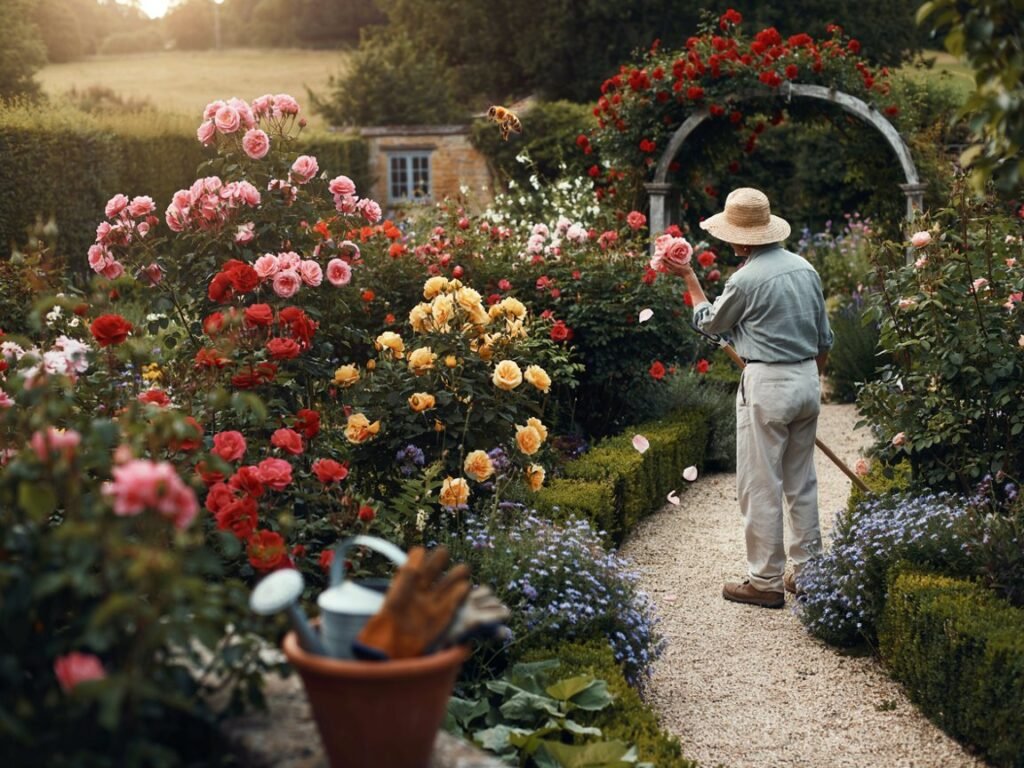
You will get scratched. This is not avoidable. Long sleeves and a pair of proper leather gardening gloves are not optional accessories — they are essential equipment. Make peace with this and carry on.
The fragrance will catch you off guard. The first morning you walk out to the garden and a breeze carries the scent of your roses to you before you even see them — that moment is genuinely something. Nobody warns you about it. It makes all the patience worth every bit of the wait.
Seasonal Care Calendar
🌱 Spring
- Early spring (before new growth begins): Prune away any dead, damaged, or crossing canes; cut back remaining canes by about one-third to encourage bushy growth
- Uncover and clear: Remove any winter mulch or protective coverings as temperatures reliably stay above freezing
- Feed: Apply your first dose of balanced rose fertilizer or a slow-release granular fertilizer as new growth emerges
- Inspect: Check for signs of pests or disease early — catching them now is far easier than dealing with them later
- Mulch: Apply 2–3 inches of fresh mulch around the base of each plant to conserve moisture and suppress weeds as the season heats up
☀️ Summer
- Water deeply once or twice a week depending on rainfall — never let roses wilt, but avoid daily shallow watering
- Deadhead regularly on repeat bloomers to keep flowers coming — skip this on once-blooming varieties that produce decorative rose hips
- Feed monthly through midsummer (stop feeding in late summer to avoid pushing tender growth that won’t harden before frost)
- Watch for pests: Check the undersides of leaves for aphids (knock them off with a blast of water), and monitor for black spot and mildew in humid weather
- Tie in climbers: As climbing roses produce new canes, guide and tie them to their support structure — horizontal training encourages more flowering
🍂 Fall
- Stop deadheading about six weeks before your first expected frost — this signals the plant to wind down for the season
- Stop fertilizing: No feeding after late summer
- Plant new roses: Fall is actually an excellent time to plant — cooler temperatures reduce transplant stress and give roots time to establish before winter
- Clean up: Remove fallen leaves (especially any affected by black spot) from around the base — they harbor disease spores that overwinter in the soil
- Prepare for cold: In zones 5 and colder, mound soil or compost 8–10 inches around the base of plants after the first hard frost to protect the bud union
❄️ Winter
- In mild climates (zones 7–9): Roses may continue blooming; water during dry spells and otherwise leave them alone
- In cold climates (zones 4–6): Keep winter protection in place until the last hard frost has reliably passed; resist the urge to remove mulch during a warm spell in February
- Order and plan: Winter is the best time to browse catalogs, plan new additions, and order bare-root roses for spring delivery — the selection is widest and the prices lowest when you order in advance
- Care for your tools: Clean, sharpen, and oil your pruning shears so they’re ready for the spring rush
Key Takeaways
- The idea that roses are difficult is based on old varieties — modern shrub and groundcover roses are genuinely beginner-friendly
- Six hours of direct sun and well-draining soil are the two non-negotiable requirements; everything else is adjustable
- Start smaller than you think you should — a 4×4 garden that thrives will teach you everything you need to expand confidently
- The first summer is about roots, not blooms; the second summer is the payoff
- Disease-resistant varieties like Knock Out, The Fairy, and New Dawn do most of the work themselves
Plant one rose this season. Just one. Then watch what happens in the second summer — and try not to immediately plant six more.